Websites that bring customers in.Software that handles them once they're here.
For businesses still running on WhatsApp, paper and memory — workflow, staff hours, cash, rotas.
I'm Ali-Noor Razak. AR Labs is two things that belong together: web development and custom software. The site that brings the work in, and the system that handles it once it arrives — database, app, deployment, end to end.
Small businesses, whatever the trade. What I'm usually replacing is a group chat, a notepad and somebody's memory.
01 What it's for
Five things, and what each one actually means.
Every agency promises all of these. So here is what each one looks like in practice, specifically enough that you can hold me to it afterwards.
- Save time The admin that eats your evening — rotas, hours, chasing people for numbers. Worked out once, properly, instead of again every week.
- Stop money leaking No more £20 missing from the till and nobody able to say where it went. Cash and hours that still add up on Sunday night.
- Make more money Capacity you already have but can't see: jobs quietly dropped, follow-ups nobody made, hours billed short because no one wrote them down.
- Get more customers A site that loads fast, says what you do in ten seconds, and makes getting hold of you easy — built so search engines can actually read it.
- Fix the workflow No more “whose turn is it”. One place the job lives, so the argument stops happening at all.
02 What I build
Two halves of the same job.
- Websites Fast, clear and findable. Written for the customer deciding in ten seconds whether you do what they need, and built to work on a phone on bad mobile data — because that's where most of them are.
- Custom software The part off-the-shelf won't do. Dispatch boards, staff hours, cash ledgers, bookings, stock — built around the way you already work rather than forcing you into someone else's.
- The jobs that run themselves Posts that go out to your socials on a schedule instead of whenever someone remembers, and a bot that answers the same five questions in your DMs so you only see the ones worth answering.
- The joins between them So the enquiry from your website doesn't get retyped into three other places by hand, and the numbers in one thing match the numbers in the next.
03 How the work goes
One person, the whole thing.
I design it, build it and run it — which means there is no one to hand off to, and nothing gets lost in the handover. Same for a five-page site as for a system your staff live in all day.
- Work out what the job really is. Usually by watching how you work now, not by asking you to write a spec. The thing you complain about is rarely the thing that's broken.
- Design it around the worst moment. Not the demo — 8pm on a Friday, hands full, phone going, everything happening at once.
- Build it properly. Database, permissions, the app or site on top. Your data separated from everyone else's, and records that still add up at the end of the week.
- Put it live and keep it alive. On the phones your staff already own. Shipping is the easy half; staying up is the job.
04 Case study
Sparky Study Notes
sparkystudynotes.co.ukThe problem
A trainee electrician working towards their Level 3 sits six separate exams: 18th Edition BS 7671, Building Regulations, PAT testing, initial verification, periodic inspection and testing, and fundamental inspection and testing. They get webinars and a very large regulations book. What they don't get is a written record — the diagrams off the whiteboard, the page numbers into BS 7671, the worked examples with the numbers the tutor actually used. So everyone rewrites the same notes badly, alone, at night.
What I built
A study site built to get them through those six exams — not a course, and not a replacement for one. Every teaching session is written up with redrawn diagrams and highlighted book references, taught again in a 15–20 minute video, and backed by a PDF. There's a practice paper for each of the six exams, a 20-question test after every module with instant marking, calculators for Ohm's law, volt drop and Zs, and an AI tutor that leads with the notes and, where a question goes past them, answers from standard UK practice rather than telling the student to ask someone else.
Where it came from
It's my own product, and I'm sitting the same exams — which is the only reason the notes exist. Content, site, database and deployment are all mine, so it's a fair look at both halves of the work at once: it's a website people find and read, and an application with accounts, marking, payment and a tutor behind it. Written as the teaching ran, shipped the same week, and since taken from free to paid — which meant adding accounts, a paywall and billing to a site that began with none of them.
- Written for6 exams, 7 modules
- Masterclasses9, with tests
- Per teaching dayNotes, video, PDF, test
- Price£100 for 12 months
- StatusAll 14 parts written up
05 Case study
AR Labs Dispatch
Live · in daily useThe problem
A takeaway that runs its own drivers is operating four systems at once, and none of them speak to each other: orders arriving from Just Eat, Deliveroo and Uber Eats on a separate tablet each, a paper list of who has gone where, a drawer of float money nobody can reconcile at midnight, and a group chat for everything else. On a Friday night nobody can answer the two questions that actually matter — where is that order, and does the cash add up.
What I built
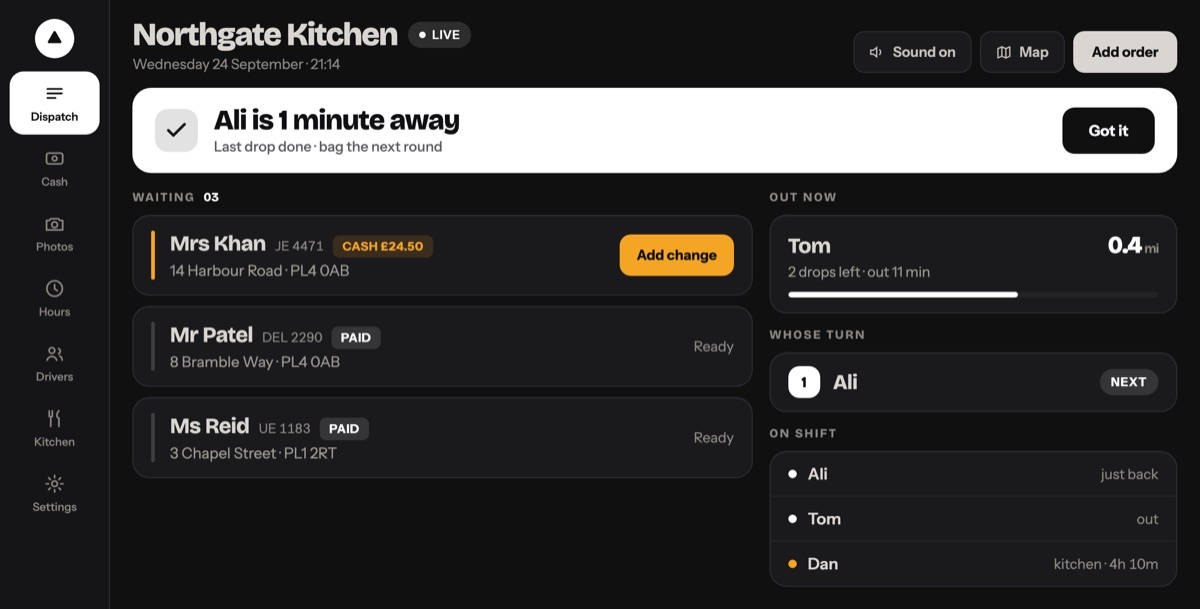
Three things on one database. A dispatch board the manager watches on a tablet, a phone app the drivers carry, and a kiosk the kitchen clocks on and off at. I built it for a takeaway after standing in one and watching a service — the design came from how they already worked, not from a spec anybody wrote down.
How a round actually works
- The order arrives. Typed in by hand with the postcode looked up, read off the platform’s own notification email, or photographed by the kitchen — it snaps the receipt, and the order lands on the board under the shop’s own number.
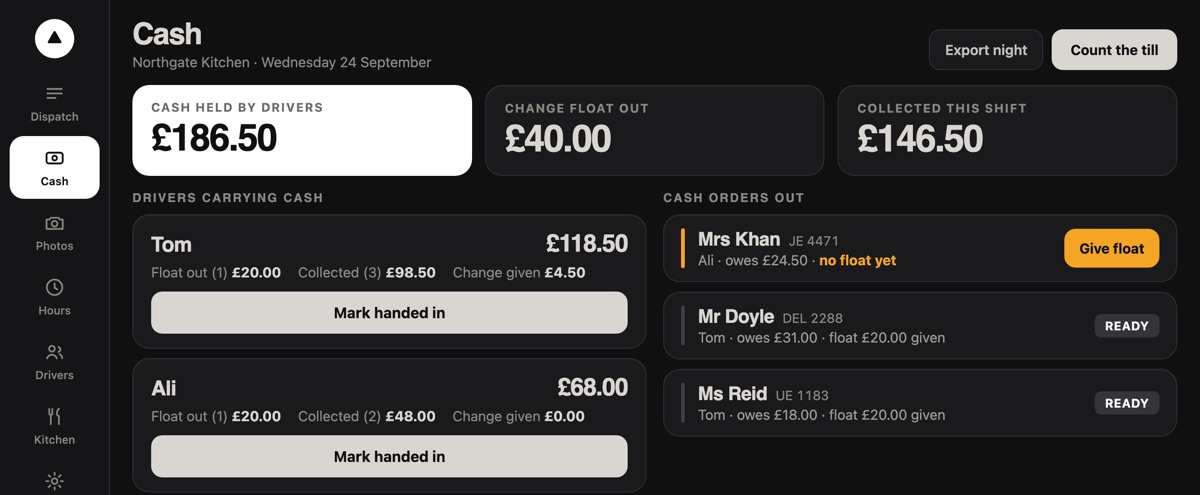
- The board groups it. Drops going the same way get offered as one round. Cash orders are flagged with what the customer owes before a driver touches them.
- A driver takes it. There’s a queue, so it’s whoever’s turn it is rather than whoever shouts. The addresses only reveal once the round is accepted, so nobody cherry-picks the short ones.
- Out and back. Straight into Waze or Maps, a photo at the door before the drop will even register, change counted out on screen, and the drive back is in the app too — with the board calling out a driver half a mile away so the next bags are ready.
- The money is settled. Every float issued and returned is logged with who handed it over and who took it back, so the till is counted against a record rather than against memory.
Turning things on and off
No two shops want the same product. Doorstep photos, the kitchen’s receipt snap, the board speaking out loud, the driver queue, the leaderboard, speed limits, the reviews panel — each is a switch in that shop’s own settings, so one can run with all of it and another with almost none. The look follows the same idea. Anything not on that list gets built and added; it’s one codebase, so a shop asking for something new isn’t asking for a fork of it.
What it taught me
Reading the code found nothing. One pass through a real round, on a real phone, found eleven faults — including cash failing at a customer’s door because the app checked the driver’s money but not whether a float had been issued for that order. That’s the whole argument for designing around the worst moment rather than the demo, and it’s why I now test by using a thing rather than by reading it.
- PartsBoard, driver app, kitchen kiosk
- Order sourcesPlatform email, manual, receipt photo
- Database199 migrations, locked per shop
- Domain tests475, all passing
- Per-shop switches7, plus the look
The shop in these two screens is invented, and so is every name, address and order on them.
06 Getting hold of me
Tell me what the job is.
One paragraph is plenty — the site you need, or the thing that goes wrong most weeks and how you handle it now. I'll tell you honestly what I'd build, what I wouldn't, and where something off the shelf would do the job cheaper.
Or email me directly:
hello@arlabs.co.uk